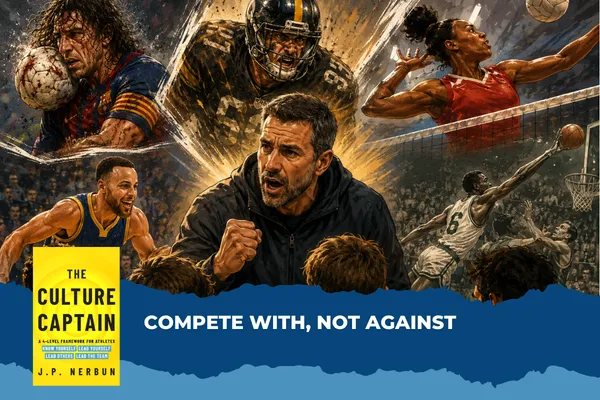
Compete With, Not Against (part 2)
Part 2 of Chapter 10 of The Culture Captain (Read Part 1 Here)
(Launches June 9th, Available for Pre-Order Now! Kindle Pre-Order | Bulk Discounts)
The ultimate goal of the competitor is to use the opposition to discover their own greatness.
— W. Timothy Gallwey
Many people think competition means “competing against”: for me to win, you have to lose. But as Lily learned from Brie, competition at its best means “competing with”—not just with your teammates, but your opponents as well.
Competing as Physical Sacrifice
In Sam Walker’s study of the most dominant teams in history, he found that “Tier One” captains shared a specific trait: extreme doggedness. They played to the absolute edge of their physical capabilities and the rules of the game, often leaving the field looking like they’d been in a war.
Carles Puyol was known as “the shark” and “the human shield” for FC Barcelona. He would block “kicks” with his face and play through a litany of injuries. He viewed his body as a tool for the team, once having a gaping wound stapled shut on the sideline just to avoid missing a minute of play. When asked why he would sacrifice his physical safety for a mid-season match, his answer was a masterclass in competere: “I have always felt I had to give everything. That’s how I’ve always been. It’s my way of respecting football and respecting my teammates.”[i]
Another Tier One leader, Jack Lambert, was known as “Dracula in Cleats” as a linebacker for the legendary Pittsburgh Steelers defense. With his missing front teeth and “rusty barbed wire” frame, Lambert viewed a clean uniform as a personal insult to the game.[ii] He understood that his physical sacrifice was the price of admission for team greatness.
And it was the same fire that drove Cuba’s captain Mireya Luis to a volleyball court for practice just four days after giving birth and then leading them to a silver medal in the 1986 World Championships just ten days later.[iii]
Competing as a Way of Caring
Behavioral science now confirms what great coaches have always known: Effort is transferable. When a leader operates at 100%, it creates a psychological “pull” on everyone else in the group. It does more than just inspire their teammates; it uplevels the standards of the whole team.
Take Steph Curry, the wiry guard who redefined the game of basketball with his 3-point shooting and his joy. His teammates don’t just describe him as the greatest shooter ever; they describe him as a “contagion.” Former Warriors general manager Bob Myers calls him the most competitive person he’s ever met. Curry doesn’t compete with a snarl; he does it with a smile. As assistant coach Luke Loucks says, “He is trying to kill everyone. But he does it with a smile on his face and joy. There’s this uncharacteristic competitive spirit he has that’s contagious around the whole organization.”[iv]
His teammate, Steve Rossiter, explains this perfectly: “In practice, if Steph is diving on the floor, I better have my five-point-a-game-averaging ass diving on the floor too. When your best player is also giving the most effort and supporting everyone, that’s how his leadership shines through.”[v] When the person with the most status is willing to do the dirtiest work, it becomes socially impossible for others to stand by and just watch. A leader doesn’t have to tell people to work harder; they make it embarrassing not to.
Many athletes hold back because they want to be “nice” or “liked.” They fear that playing too hard will upset their teammates. But the truly great understand that extreme competition is an act of love. By pushing your teammates to their limit, you are helping them find theirs.
Competing for the Team
The most powerful fuel for competitiveness isn’t ego—it’s responsibility. When you compete for yourself, your fire wanes when things aren’t going well. When you compete for the person next to you, the fire is reignited.
In Game 7 of the 1957 Finals, Bill Russell missed a potential game-winning dunk. Instead of sulking, he turned his failure into a 94-foot sprint to block a breakaway layup, winning his first NBA Finals for the Boston Celtics. This type of competitiveness became one of the defining qualities of his career as he would go on to lead the Celtics to 11 NBA championships. His thinking: “My ego demands—for myself—the success of my team.”[vi]
Chapter 10: Compete
[i] Sam Walker, The Captain’s Class (Penguin, 2017), 109.
[ii] Walker, The Captain’s Class.
[iii] Walker, The Captain’s Class.
[iv] The Athletic Staff, “The Athletic: Why 1 Simple Word Defines Stephen Curry’s Leadership with the Warriors,” NBA.com, April 24, 2025, https://www.nba.com/news/the-athletic-why-1-simple-word-defines-stephen-currys-leadership-with-the-warriors.
[v] Elise Devlin, “What Can We Learn from Steph Curry About Leadership?” The Athletic, April 25, 2025, https://www.nytimes.com/athletic/6305603/2025/04/25/what-can-we-learn-from-steph-curry-about-leadership-our-4-favorite-lessons/?source=user_shared_article.
[vi] Walker, The Captain’s Class.


