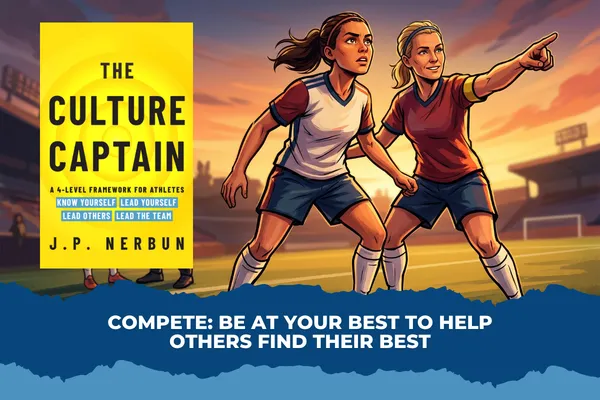
Compete: Be at Your Best to Help Others Find Their Best
Part 1 of Chapter 10 of The Culture Captain
(Launches June 9th, Available for Pre-Order Now! Kindle Pre-Order | Bulk Discounts)
In the first practice of the year, Lily was paired up in 1-on-1 games with Brie, the team captain. Brie was all out from the start—physical, aggressive, and not taking it easy on Lily at all. Lily smiled and went right back at her.
When they started a practice game, the intensity was unlike anything Lily had experienced. Once again, it was being dictated by Brie. Brie didn’t just play; she patrolled the field like a shield. She was throwing her body into passing lanes, grunting through shoulder-to-shoulder contact, and sprinting all out.
Watching Brie, Lily felt energized, and all the work on her fitness this offseason gave her the ability to match Brie’s competitive fire. The two of them playing on opposite teams were playing as if possessed.
Then, Lily saw her opening to make a big play. Maya was playing passive and safe, exposing herself. Lily timed the tackle perfectly, executing a clean challenge that sent the ball flying and Maya tumbling.
Maya sat up, clutching her face as a thin stream of red leaked from her nose.
“Seriously, Lily?!” Maya hissed, throwing her hand up toward the coaches. “No foul? She’s trying to kill me!”
Maya stormed off to the trainer, leaving Lily standing in a cold silence. Lily’s stomach did a slow roll. The “good teammate” in her wanted to apologize, to shrink back, to promise it wouldn’t happen again.
After practice, as Lily sat on the bench staring at her cleats, Brie sat down next to her.
“Hey,” Brie said, bumping Lily’s shoulder. “I loved competing with you today, that was a great start to the season.”
“Maya doesn’t think so,” Lily muttered. “I was loving the competition as well, but then that happens and I find myself holding back again. I don’t like upsetting people, making them look bad, and I definitely don’t want to hurt someone.”
Brie leaned back. “Lily, what do you think it means to compete?”
“To play your hardest to beat the person or team you are playing against,” Lily answered.
“That’s today’s version of compete,” Brie said with a small smirk. “Most people see it as competing against. But I see it as competing with.”
Lily looked up, confused. “What’s the difference?”
“Alright, this is going to sound a bit like a history lesson, but stick with me,” Brie said. “My old coach taught me something really interesting. The word compete is over 2,000 years old. Back in the Roman Empire, when they spoke Latin, the word was competere.”
Brie held up two fingers. “Com meant ‘together.’ Petere meant ‘to strive, to seek, or to fly.’ It didn’t mean to crush someone. It literally meant ‘to strive together.’ Or, even more poetically, ‘to fly together.’ ”
“To fly together?” Lily repeated.
“Yeah. Around the 1600s, the meaning changed. It shifted from striving for excellence to striving for a prize. It went from ‘I need you to be at your best so I can find my best’ to ‘I need you to lose so I can win.’ ” Brie looked Lily dead in the eye. “Today, I wasn’t competing against you. I was competing with you. I was pushing you to your edge so you could see how far you could go. When you tackled Maya, you weren’t trying to show her up. You were challenging her to get better at protecting the ball and play with more intensity.”
“But she’s not happy,” Lily argued. “She thinks I’m a headhunter.”
“That’s one of the costs of leadership,” Brie said. “It’s my job as captain to set the culture by my example. I have to challenge players with my play and then have the hard conversations to get people like Maya on board with the standard. Coach Molly wants a competitive culture. It’s why we compete so much in practice. Maya will be fine. For now, you keep competing with me and start bringing a few other girls into the slipstream with you. Don’t apologize for flying, Lily.”
—J.P. Nerbun
P.S. Mark your calendar. My new book, The Culture Captain, is coming June 9th.
If you missed yesterday’s email, CLICK HERE to enter the giveaway, pre-order, and get bulk discounts!
P.P.S. Join our TOC Coach Community for FREE — Better Coaches, Better Leaders, Better Culture.
P.P.P.S. Want to learn how we help coaches at all levels develop their leadership philosophy, establish team standards, & create better team cultures? Book a call with us and we’ll help you solve your biggest problem.


