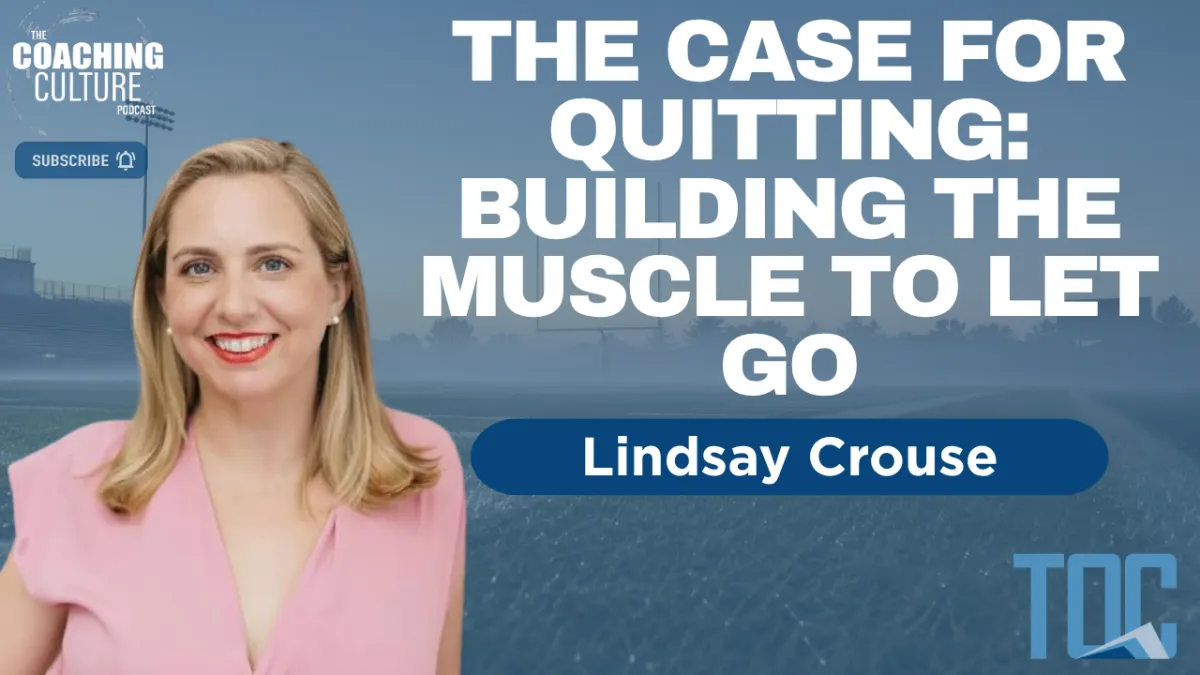
Episode 469: The Case for Quitting: Building the Muscle to Let Go | Lindsay Crouse | Part 2
Episode 469: The Case for Quitting: Building the Muscle to Let Go | Lindsay Crouse | Part 2
Podcast accessible on: iTunes | Spotify | YouTube
Last week, we posed a hard question to journalist Lindsay Crouse: what if quitting isn't the failure we've been taught to fear? The response in our community told me this topic hit a nerve with a lot of coaches who are carrying more than they're saying out loud.
In part two of this conversation, Lindsay and JP go further into what actually happens once you admit the grind has stopped working. They talk through Simone Biles' Olympic decision, the physical cost Lindsay put her own body through before she learned to listen to it, and why she believes quitting is a muscle you build through practice, not a moment of certainty.
If part one left you thinking about what you might need to let go of, this episode gives you the how.
TOC 3-2-1
3 QUOTES WORTH WRITING DOWN
"Our culture teaches us that quitting is a failure, that we didn't try hard enough. But quitting can be the first step to something better."
— Lindsay Crouse
"You just have to build this muscle around quitting. That's really the only way that we can grow."
— Lindsay Crouse
"I think about some of the people I respect a lot. They've quit things, and I've really respected them for how they quit and the reasons why they quit."
— JP Nerbun
2 QUESTIONS FOR YOUR TEAM
Q1: What's one situation where you're pushing an athlete, or yourself, toward more, when the data or the body is already telling you it's time to pull back?
Q2: If quitting is a muscle, when's the last time you actually practiced it, on purpose, in something small?
1 RESOURCE TO GO DEEPER

The Case for Quitting: The Surprising Benefits of Opting Out by Lindsay Crouse
A 15-year New York Times veteran makes the research-backed case that stepping back is often the braver, smarter choice than pushing through.
KEY TAKEAWAYS
Your Mind Lies About Your Limits, Your Body Doesn't. Lindsay describes icing a stress fracture under her desk at work rather than stop running, going so far as to give herself frostbite. She argues that elite performers eventually learn to trust data and physical signals over the story their mind tells about how much more they can take. Coaches fighting to get athletes to trust GPS data or rest protocols are fighting this exact instinct.
Simone Biles Didn't Quit, She Read the Information. Lindsay reframes the 2021 Olympic decision that drew heavy criticism. Biles had already tested the skill in warmup and it wasn't working. The choice to step back wasn't a loss of nerve, it was a rational response to real evidence, made under a spotlight that was not imagined.
Define "Enough" Before the Season Starts, Not During It. High achievers often get stuck on what Lindsay calls the hedonic treadmill, where the goalposts for satisfaction keep moving no matter how much is accomplished. She recommends deciding in advance what will count as enough, so ambition doesn't quietly turn into permanent dissatisfaction for a team or a coach.
Separate What You Want From What You Need. Lindsay draws a distinction between the wants and needs tied to any pursuit, using her own marathon training as an example. It is work she wants to do and work that keeps her healthy, but it does not need to be paid to be worth doing. Coaches can help athletes untangle which parts of a sport are actually serving them.
Quitting Gets Easier With Practice, Not Certainty. When Lindsay left a stable global health career for an entry level, lower paying job at The New York Times, she didn't have more information, she had the same uncertainty everyone has before a big change. She argues the only way through is building the habit of making the call anyway, which gets easier each time it's practiced.
The Traits That Made You Good Don't Disappear When You Walk Away. Whether it's a sport, a job, or a role on staff, Lindsay reminds listeners that the discipline, effort, and care that helped someone succeed carry them into whatever comes next. Quitting a pursuit is not the same as quitting the qualities that built it.
ACTION ITEMS FOR LEADERS AND COACHES
AUDIT ONE GRIND HABIT
Identify one thing you or your team does out of pure effort with no clear payoff, and cut it for a week to see what changes.
NAME YOUR ENOUGH
Write down, in one sentence, what would count as a successful season before results start rolling in.
PRACTICE A SMALL QUIT
Choose one low stakes commitment to intentionally step away from this month, just to build the skill.
RUN THE INFORMATION TEST
Before pushing an athlete harder, ask what data, film, GPS, and their own words are already telling you, then act on it.
Get notes and tools at tocculture.com | Join TOC Coach — community, courses, and live coaching | Better Coaches. Better Leaders. Better Culture.
