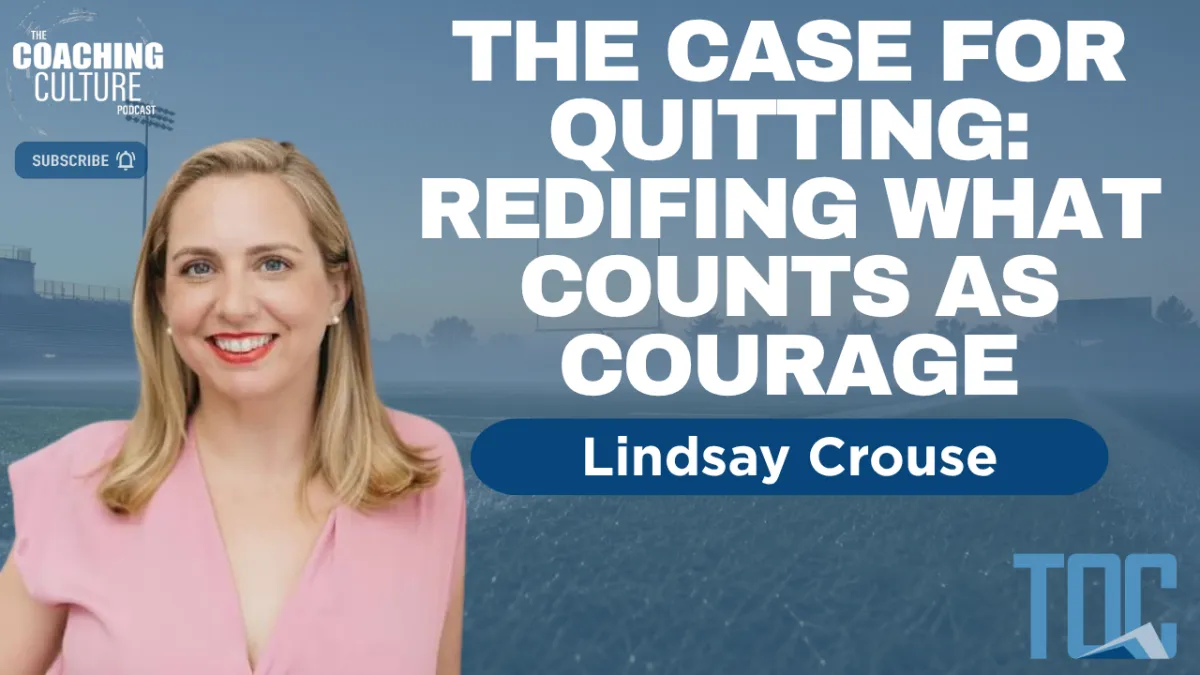
Episode 468: The Case for Quitting: Redefining What Counts as Courage | Lindsay Crouse | Part 1
Episode 468: The Case for Quitting: Redefining What Counts as Courage | Lindsay Crouse | Part 1
Podcast accessible on: iTunes | Spotify | YouTube
You might have heard similar things from coaches in your network; I know I have. They are exhausted, they are grinding through a schedule that never lets up, and somewhere underneath it all is a quiet fear that slowing down means they are not committed enough.
This week's episode goes straight at that fear. JP sits down with journalist and author Lindsay Crouse, whose new book The Case for Quitting argues that the thing we treat as the ultimate sports sin, stepping back, is often the smartest move a competitor can make. She and JP dig into where that never-quit instinct actually comes from and why our brains default to staying on a path long after it stops working.
If you have ever pushed an athlete, or yourself, past the point of usefulness because stopping felt like losing, this conversation will change how you think about the word quit.
TOC 3-2-1
3 QUOTES WORTH WRITING DOWN
"Quitting is not simply a failure of resolve or an easy way out. Often it's a courageous first step to something better."
— Lindsay Crouse
"Our brains prefer not to decide. They prefer to slide, to continue down the path we're already on."
— Lindsay Crouse
"My identity wasn't even just a basketball player. My identity was the guy who had this dream."
— JP Nerbun
2 QUESTIONS FOR YOUR TEAM
Q1: Where in your season are you "sliding" instead of deciding, just because it's the path you already know?
Q2: If you set a deadline to reassess one commitment on your team right now, what would that deadline be, and what would make you actually keep it?
1 RESOURCE TO GO DEEPER

The Case for Quitting: The Surprising Benefits of Opting Out by Lindsay Crouse
A 15-year New York Times veteran makes the research-backed case that stepping back is often the braver, smarter choice than pushing through.
KEY TAKEAWAYS
Perseverance Is Not the Same Thing as Success Lindsay grew up believing that finishing anything, a race, a book, a job, was itself the win. It took years of writing about elite athletes to realize that finishing a task that is hurting you is not the same as succeeding at it. Coaches praise athletes for gutting things out, but if the effort isn't moving a player closer to their actual goal, the praise reinforces the wrong lesson.
Staying Is a Decision, Not a Default. Lindsay pushes back on the idea that quitting is the only real choice being made. Staying is a choice too, and our brains default to it because it's more comfortable than deciding. For coaches, this means the players who never complain and stick with a role may not be committed, they may just be avoiding a harder conversation.
Set a Deadline Before You Start. Lindsay's biggest regret with things like the clarinet or a fading athletic path wasn't quitting, it was never giving herself an honest checkpoint to reassess. She recommends deciding in advance when you'll stop and evaluate whether a pursuit is still working, rather than letting momentum make the decision for you.
We Regret the Roads We Never Tried, Not the Ones We Left. Citing Cornell psychologist Tom Gilovich, Lindsay explains that people rarely regret leaving something that wasn't working. What haunts people long term is not trying something else, not exploring, not taking the risk. Coaches can use this to help athletes separate fear of what teammates will think from what actually serves them.
Rest Isn't the Absence of Discipline, It's a Tool. Lindsay tells the story of Roger Bannister, who stopped training entirely for three days before breaking the four minute mile, choosing to climb mountains in Scotland instead. That kind of leisure based rest, distinct from scrolling in bed, restored his motivation and led directly to a breakthrough.
You Don't Leave Your Strengths Behind When You Quit Something. Drawing on psychoanalyst Erich Fromm's distinction between having and being, Lindsay reminds listeners that identity built on values such as hard work, kindness, and perseverance accompanies a person into whatever comes next. Letting go of a role or a sport doesn't mean losing the traits that made someone good at it.
ACTION ITEMS FOR LEADERS AND COACHES
SET A REASSESSMENT DATE
Pick one commitment on your team right now, a drill, a rotation, a captain structure, and set a specific date to evaluate whether it's still working.
NAME THE DEFAULT
Ask your staff which current routines exist because they work versus because no one has ever questioned them.
BUILD IN REAL REST THIS WEEK
Schedule one team activity with zero performance objective, purely for enjoyment, not a reward for hitting a benchmark.
ASK THE GILOVICH QUESTION
In your next one-on-one, ask an athlete what they'd regret more: trying something new or staying where they are.
Get notes and tools at tocculture.com | Join TOC Coach — community, courses, and live coaching | Better Coaches. Better Leaders. Better Culture.
