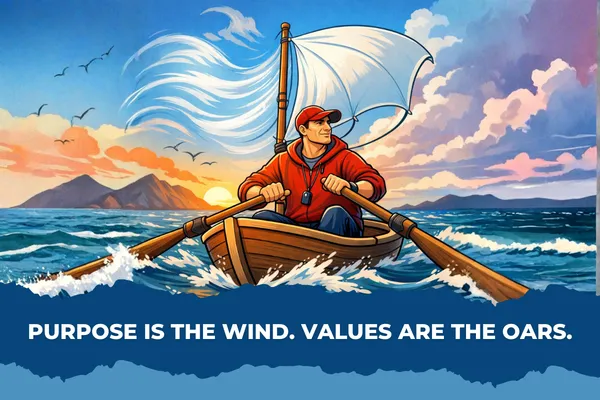
Purpose is the Wind. Values are the Oars.
Do you have a purpose? We often talk about purpose as something you find—a possession you finally "get." Whether it’s coaching, parenting, or another vocation, we say: “It gave me purpose.”
Often we go looking for it by answering the question of "Why?" Why do I coach? And yet, the process of finding a purpose often feels as stale as "shopping" for core values from a list.
You can answer the question "Why do I coach?" all day long, but having a purpose statement doesn't mean you actually feel purpose.
I’m starting to believe you don’t have a purpose; rather, you feel a sense of purpose. Some days that feeling is a roar; some days it’s a whisper.
The source of that feeling varies, and it rarely arrives in a grand purpose statement. Instead, it emerges through small, daily, intentional acts across four main domains.
The 4 Sources of Purpose
1. Relationships
In 2008, Stern Magazine asked Jürgen Klopp, "What counts in life?" He responded: "For me, life is completely about relationships. I don't want to live alone on a mountain. I want to inspire people, I want to be inspired by people, I want to love and be loved." Klopp felt purpose within the Liverpool community—but that feeling is fragile. I’m not sure he would have felt that same purpose if the majority of fans or players wanted him fired every day.
2. Impact
We have all felt the impact of a great teacher or coach. But here is a sobering thought: How much did they feel they were having an impact at the time? As leaders and parents, it is common to question daily whether we are actually moving the needle for the people around us. When the evidence of impact is thin, the feeling of purpose fades.
3. Growth
You can find purpose in using your vocation to become the person you ultimately want to be—your best self. But how often does the job do the opposite? It’s common for the pressure of results to actually drive us away from our values as we sacrifice relationships and our own personal well-being for wins.
4. Calling
For many, purpose is found in a spiritual calling. Eric Liddell, the 1924 Olympic gold medalist, famously said, “I believe God made me for a purpose—but He also made me fast. And when I run, I feel His pleasure.” Yet, even that specific purpose was seasonal– it faded or changed. In 1925, he gave up running to become a missionary in China, eventually dying in an internment camp during WWII.
When Purpose Fails, Turn to Values
It might sound like I’m ripping on purpose. I’m not. I’m just starting to look at it differently, especially after my conversation with Brad Stulberg. His advice was compelling: When purpose feels distant, come back to values.
It makes sense. Some days, you simply won't feel connected to your "Why." That’s normal. Feelings are fickle; impact is often invisible; and relationships can be strained.
Values are more concrete than purpose. Even on the days when I don't "feel" my purpose, I can still act in alignment with my values of curiosity, discipline, and gratitude. Purpose is the wind in the sails—it’s great when it’s there. But values are the oars. When the wind dies down, you keep rowing.


