
Episode 464: Why the Best Leaders Aren't the Loudest Ones | The Culture Captain: Level 3
Episode 464: Why the Best Leaders Aren't the Loudest Ones | The Culture Captain: Level 3
Podcast accessible on: iTunes | Spotify | YouTube
There's an athlete on every team I've ever been around who never gets called a leader, but the team feels different when he's not there. I didn't have language for that for a long time. I just knew practice felt a little flatter, a little more scattered, and I couldn't have told you why.
That's basically what this episode is about. JP, Betsy, and Nate dig into Level 3 leadership this week, the one-to-one, relationship-first work that JP writes about in his book. It's not the stuff that gets someone voted captain. It's noticing a teammate, having the hard conversation, being the person someone can actually be honest with. I think most of us can point to that individual on our own teams faster than we can point to the "leader."
Listen to this one and you'll walk away with language for the quiet leaders you've probably never named out loud, a ready-to-run team exercise for sorting out what "calling someone out" actually means versus "calling someone up," and a clearer read on why some of your most talented players still aren't leading the way you need them to.
TOC 3-2-1
3 QUOTES WORTH WRITING DOWN
"The problem with hard conversations isn’t not knowing the template. The problem is the belief system that gets in the way of actually changing the behavior."
— J.P. Nerbun
"One group calls it ‘called out.’ The other group calls the exact same thing, a coach stopping practice to single out an athlete, ‘called up.’ It depends on the relationship."
— Betsy Butterick
"Rizzo said he got called out by Ross more than a few times, and every single time he walked away feeling like the guy loved him."
— Nate Sanderson
2 QUESTIONS FOR YOUR TEAM
Q1: On a scale of 1 to 10, how comfortable are you calling out a teammate when they're below the standard? What belief is keeping you from a 10?
Q2: Think of one teammate you'd call out without hesitation, and one you wouldn't. What's actually different about those two relationships?
1 RESOURCE TO GO DEEPER
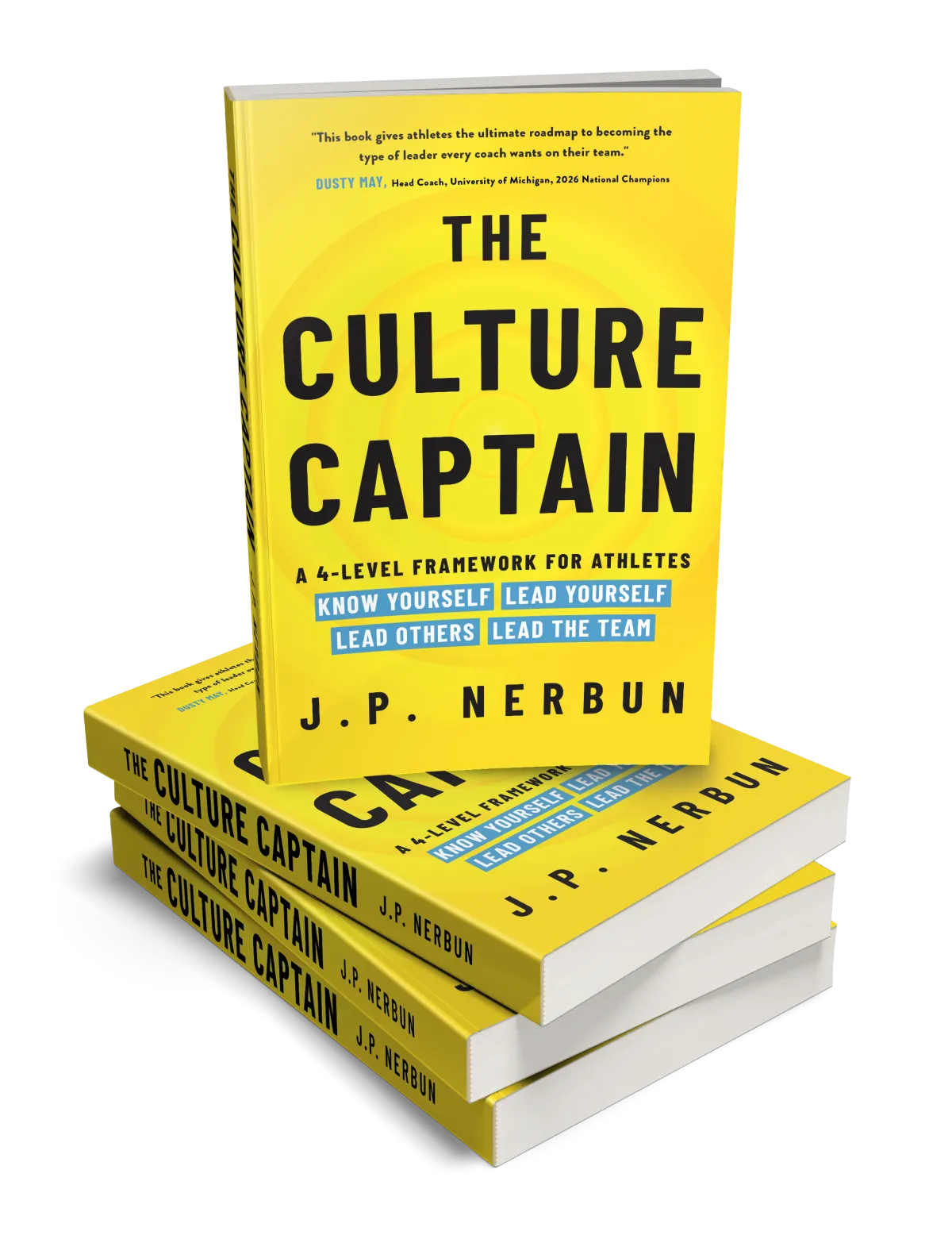
The Culture Captain by J.P. Nerbun
This episode dives into Level 1 of JP's new book — Know Yourself. It's the foundation on which every leadership conversation is built. Get The Culture Captain and the episode tools at tocculture.com
KEY TAKEAWAYS
Level three is the leadership skill coaches actually need, not level four. We often picture leadership as the loud voice organizing the huddle. That's level four. But level three, the one-to-one relational work of connecting with individual teammates, is what actually makes level four possible. Every player can be a level three leader for at least one or two people on the roster, even if they never captain the locker room.
Being a great teammate makes you a better performer, not a distraction from it. JP pointed to Joey Votto, who put in years of individual craft before realizing that investing in his teammates, learning Spanish, taking improv classes, made his career more fulfilling, not less focused. Relationship building isn't time stolen from performance. It's part of it.
Don't let ‘that's just who I am’ become the end of the conversation. When an athlete says leadership skills feel inauthentic to their personality, Betsy and Nate both push back gently: discomfort and inauthenticity aren't the same thing. The better question is what's making this uncomfortable, and where might I grow. Introverts don't need to become extroverts to lead well. They just need their own version of it.
Calling out and calling up are often the exact same behavior. Betsy's team exercise splits a page down the middle: called out on one side, called up on the other. Groups regularly put the same action, like a coach stopping practice to challenge a player, on opposite sides. The difference isn't the behavior. It's the relationship, the tone, and whether the team has practiced doing it well.
Most athletes aren't missing a script. They're stuck on a belief. Give a player a template for a hard conversation and they can usually repeat it back. What actually stops them is an unspoken belief: I haven't earned the right, it won't matter, or I'm not sure I'm right. Until coaches help players name and test those beliefs, the template alone won't change behavior.
The best challengers spend the other fifty-one weeks building connection. Nate's story about David Ross and the Cubs makes the point: Ross could challenge teammates hard, in front of the room, because he'd invested in every relationship in the clubhouse every single day. Challenge lands when it's backed by connection. Without it, the same words feel like an attack.
ACTION ITEMS FOR LEADERS AND COACHES
RUN THE SELF-ASSESSMENT
Score yourself 1 to 10 on your ability to challenge a teammate or player when they're below the standard, then name one belief that's keeping the number where it is.
TRY THE CALLED OUT VS. CALLED UP EXERCISE
Split your team into small groups with a line down the middle of a page and have them sort behaviors into both columns, then discuss where the same action landed on opposite sides.
NAME ONE GLUE PLAYER OUT LOUD
Identify a level three leader on your team who doesn't hold a formal title and tell them directly what their presence does for the group.
ASK ONE PLAYER WHAT INGREDIENT THEY ARE
Use the soup metaphor in a one-on-one conversation this week: what do you bring to this team, and how would practice feel different if you weren't here?
Get notes and tools at tocculture.com | Join TOC Coach — community, courses, and live coaching | Better Coaches. Better Leaders. Better Culture.
