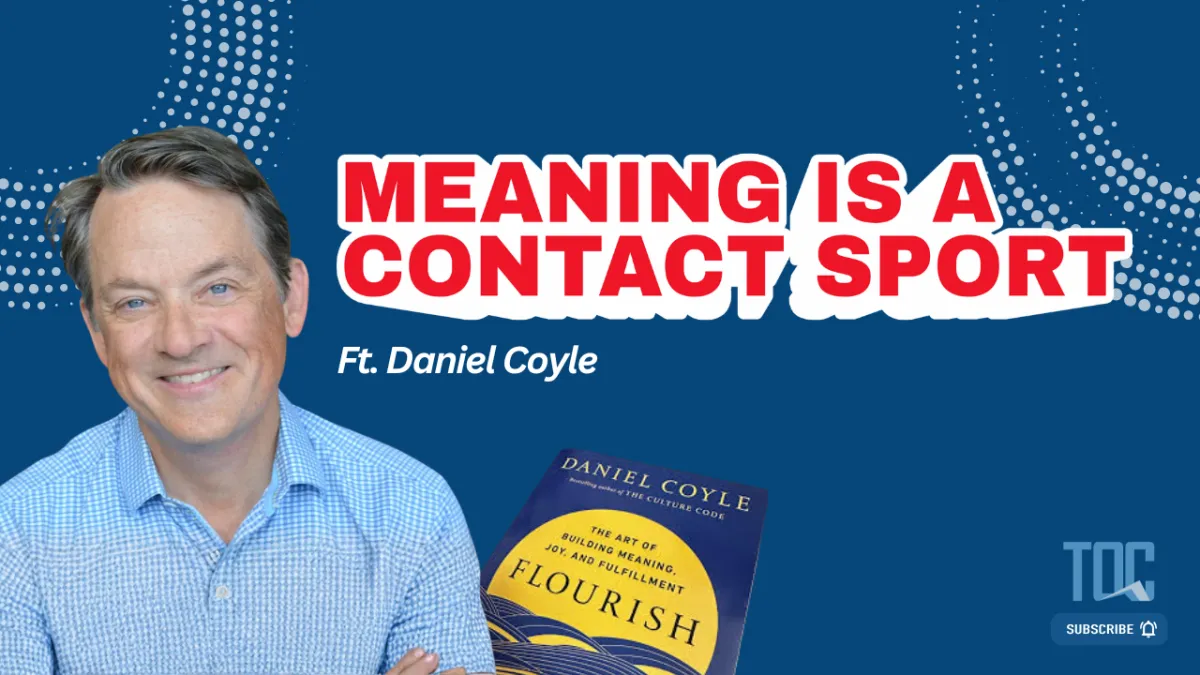
449: Flourishing, Community & the Coach's Role | Daniel Coyle
Podcast accessible on: iTunes | Spotify | YouTube
In this deeply personal and wide-ranging conversation, bestselling author Daniel Coyle joins The Coaching Culture Podcast to explore the ideas behind his newest book Flourish — a concept he sees as distinct from, yet rooted in, his earlier work on culture and talent. Coyle opens up about the losses that sparked the project, the patterns he found in thriving communities, and how coaches can become architects of meaningful moments for their teams.
The conversation moves through several interconnected themes: the "emptiness epidemic" facing high achievers, the difference between belonging and truly mattering, the surprising power of pausing in a world obsessed with speed, and why community — not just culture — is the deepest driver of human flourishing. Coyle draws on examples ranging from a Vermont town that produced 11 Olympians, to the New England Patriots' 4-H exercise, to a $90 million deli in Michigan, all to illustrate how small deliberate actions by leaders can transform the relational landscape of a team.
Key Takeaways
1. The Emptiness Epidemic Is Real — and Worth Examining
High performance does not guarantee fulfillment. Coyle observed that the most outwardly successful people he encountered often seemed hollow — accomplished on paper but adrift inside. He frames this as a gap between worldly success and an inner life of joy, deep relationships, and purpose. For coaches, this is a reminder that winning is necessary but not sufficient for the experience we want to create.
2. We Only Become Our Best Selves Through Other People
Every great individual hero story, when examined closely, reveals a community underneath it. Coyle argues that we live in an age of "late individualism" — a culture that praises solo achievement while undervaluing the relational fabric that makes it possible. Shared improvement is neurologically more powerful than self-improvement; our brains light up more when we learn and succeed together.
3. Mattering Is More Powerful Than Belonging
Belonging signals safety — "you are welcome here." Mattering goes further: "I see inherent value in you, and we need your contribution to succeed." Coaches who only build belonging cultures may be missing the key ingredient. Players don't just want to join a club; they want to know that removing them would make the team measurably weaker. Creating mattering moments is active, specific, and doesn't require much — a sentence at orientation, a question after practice, an invitation to lead.
4. Pausing Is Not Inefficiency — It's Productivity
In a world addicted to speed and answers, thriving communities consistently pause. These intentional stops — to reflect, connect, and ask big questions — are not time lost. They are the moments where meaning is built. Teams that never pause may execute efficiently but risk feeling hollow and disconnected, which ultimately costs performance.
5. Meaning Is a Contact Sport — It Must Be Co-Created
Coaches cannot transmit meaning to a team through inspirational speeches or highlight videos. Meaning happens when people discover it together, through questions, conversation, and shared experience. The coach's highest-leverage role is as a designer of those moments — asking the right question, setting up the right environment, and then getting out of the way.
Action Items for Leaders
Run the 4-H Exercise with Your Team: Gather your team in small groups and have each person share their Hero (who inspires them), Heartbreak (a setback they overcame), History (where they're from and what shaped them), and Hopes (what they want from this season or project). Do it yourself first. Budget 15–20 minutes. It costs nothing and creates the kind of connection that takes months to build otherwise.
Audit Your Schedule for Meaningful Pauses: Review your weekly schedule. Identify moments where you could build in brief pauses for reflection — even a two-minute after-action review (AAR) at the end of practice asking "What went well? If you could change one thing, what would it be?" These micro-pauses activate relational attention and signal that contribution matters.
Reframe Your Welcome Message for New Team Members: Instead of telling new players or staff what they need to do to succeed, flip the script. Say: "We're glad to have your fresh eyes. You'll notice things we've stopped seeing. Please share what you observe." That single sentence shifts the dynamic from transmission to invitation — and from belonging to mattering.
Create One Mattering Moment Per Week: Identify at least one athlete or staff member each week and explicitly tell them what unique value they bring to the team — not generically, but specifically. Reference something they did. Name something they are. This doesn't require extra time; it requires attention and intention.


